








BROWSING:  Tech

Dr. Mihai Burzo, Associate Professor of Engineering at UM-Flint, is interested in heat transfer and human physiological response. For over eight years at UM-Flint and now at its new College of Innovation and Technology, he has been conducting research on thermoreflectance (thermal behavior of microelectronic devices) and human response to external stimuli. Analyzing data drawn from human physiological changes (heart rate, skin temperature, skin response such as sweating, etc.) gathered from multiple sensors and camera arrays, Dr. Burzo has been able to analyze and predict stress levels, driver awareness, deception and thermal discomfort. As a result of his research, Dr. Burzo has recently been awarded a patent for climate control technology that could revolutionize the way the world heats and cools its private and common areas for the comfort of its people and conservation of energy.

Dr. Marty Kaufman, Professor of Geography, Planning and Environment at UM-Flint, and student Paul Mattern were worried. The planet was heating up, temperatures were pushing above normal and people were getting sick. “People don’t realize it, but excessive heat kills nearly 1,300 people per year in the United States,” explains Kaufman. “In fact, most heat-related deaths are attributed to other diseases and sickness that can be caused by excessive heat.” Those who are the most vulnerable to heat are children and the elderly with personal isolation and certain environmental factors (lack of tree cover, asphalt, standing water, etc.) contributing to the problem. With the goal of saving lives, Kaufman and Mattern searched for a way to create an excessive heat-warning system at the ground level. “We wanted to build a ground network to provide real-time heat readings,” the professor explains, “without relying on a satellite system that may not be telling the whole story.” Mattern, who works as manager of planning and scheduling at MTA, had an idea. “He came up with a plan to install heat sensors at MTA bus stops around Flint,” says Kaufman. “They worked perfectly. The bus signs were the right height and their locations made sense.”

Based in Flint, Kuhmute is leading the way in electric vehicle (EV) infrastructure providing a place for people to rent or charge an EV in cities across the United States and Canada. “We have hubs in Michigan in Detroit and Grand Haven,” says Kuhmute Software Engineer Eddie Wenzel, “and we have hubs in Illinois, Arizona and Ontario in Canada. We currently have nine in Flint with a plan in place for five more.” Kuhmute charging hubs are revolutionizing the way cities and towns think of mobility by providing a way for pedestrians to “motor” about town in a more fun and cost-efficient manner.

As the world went into lockdown at the beginning of summer, travel became an afterthought. People were asked to stay home and many complied as the world fought to limit coronavirus transmission. The quarantine hurt airlines and other industries that rely on tourism and business travel. Flint Bishop International Airport (BIA) was no exception; however, BIA leadership made the decision to adapt around a rule of safety and progress. “When the virus hit, we started looking for ways to improve safety and work within CDC guidelines,” explains Airport Director, Nino Sapone. “Europe was ahead of us in terms of infection detection technology, so we looked there for a solution.” In August, BIA became the first to utilize the Smart Helmet developed in Rome, Italy by tech company, Keybiz.

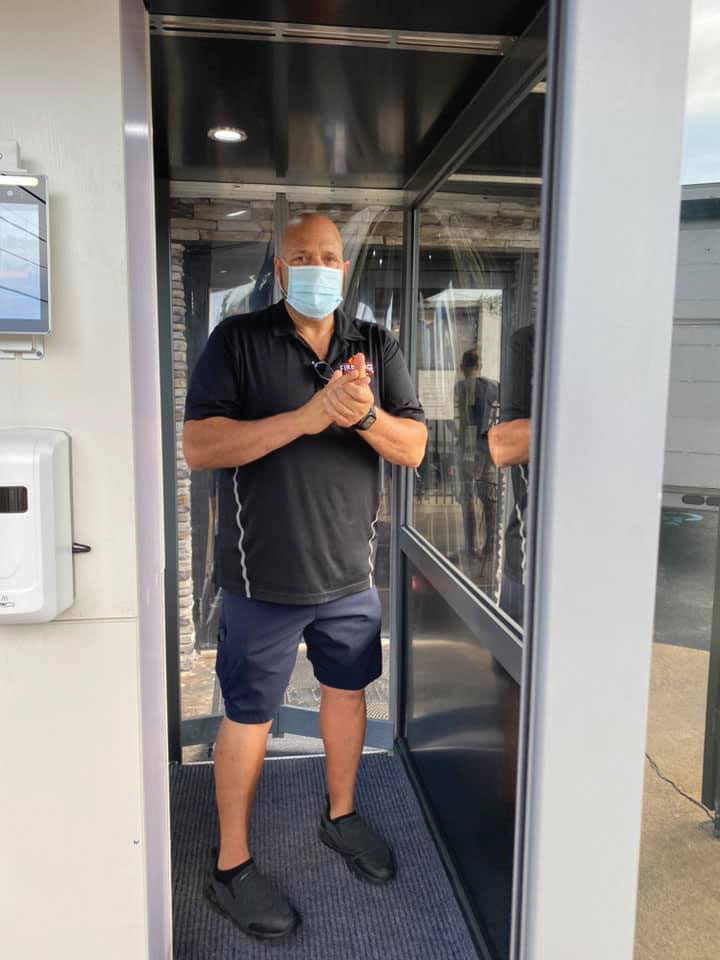
In December, 2019 as the coronavirus pandemic ravaged China and Eastern Europe, Genatek Global President, John Cooper, had a prescient idea. “We looked at the pandemic while it was overseas and realized that the United States would be in the same predicament,” says Cooper. “We paid attention to travel and shipping and we saw the trend, so we started to engineer a device to help with sanitation and disinfection.” The result was the Genatek Global GT-1000 – an 8-foot by 4-foot enclosed unit developed to keep the population safe from contagious disease. Built to follow CDC COVID-19 guidelines, the unit features a temperature and mask recognition scanner, hand sanitizer dispenser and a sanitizing micro-mist. “When a person voluntarily enters the unit, they first undergo a non-contact temperature scan and then, a facial recognition scan to check for a mask and our software is 99.8% accurate,” informs Cooper. “The person can dispense hand sanitizer and then move forward into the next enclosure to be disinfected by our micro-mist solution.”

In the past couple of years, the UM-Flint Engineering program has doubled and has grown exponentially, according to John O’Brien, Engineering Technician in the new design space that opened last winter to support the progress. O’Brien works alongside fellow engineering technician, Greg Keller, and says “we are a team and anything the professors or students need help with in the design space or on any of the machines, we do it. We make sure everything here runs smoothly for them.”

IN late June, the University of Michigan-Flint held its first ever GEMS (Girls in Engineering, Math and Science) day camp for middle school students. My City Magazine sat down with Dr. Chris Pearson, Professor of Physics and Associate Dean of the College of Arts & Sciences, who organized this exciting event on the Downtown Flint campus.

Jake Reitano, 29, a Genesee County 911 telecommunicator, sits in front of five computer screens and is ready to receive 911 emergency voice calls from residents in need. As of six months ago, he can respond to 911 text messages – from those who might be facing a circumstance in which using their voice could escalate their dangerous situation.

hotrodhigh-7The coolest kids around are those participating in the Back to the Bricks’ up-and-coming program, Hot Rod High.


Yes, dreams do come true. For Stacie Scherman, who recently obtained her graduate degree in English at University of Michigan-Flint, her dream of business ownership became a reality this year with the launch of the Flint Podcasting Company. In starting the business, Stacie has merged her talents and her passion for Flint. “I will produce some of the podcasts myself, as well as host podcasts produced by other people,” Stacie says.

Grand Circus, Michigan Council of Women in Technology, and TekSystems are working in conjunction with The Hagerman Foundation, a non-profit organization based in Downtown Flint, to bring Grand Circus’s Develop(her) Bootcamp, an intensive training course teaching students to become Java developers.