







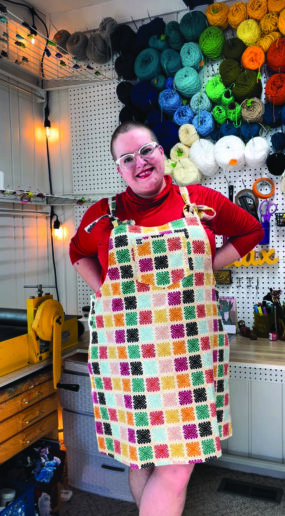
For local artist Janice McCoy, making art is as necessary and natural as breathing or drinking water. She loves to draw and paint but works primarily in linoleum printmaking. “I’ve loved making things since early in my childhood,” she shares. Her fondest memories are of drawing in kindergarten and different elementary school art class projects. She also took art classes in middle school and high school but was never really encouraged to look at art as a viable career option.
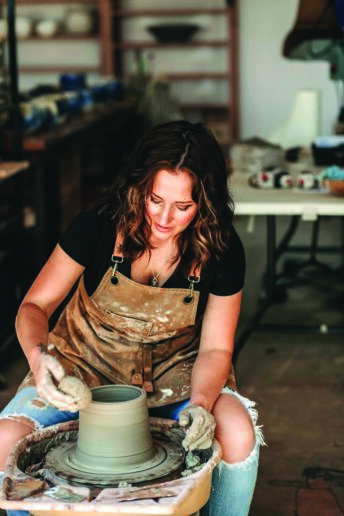
At Native House Ceramic Co., Meg Bundy harnesses the beauty, power, durability and forgiveness of the earth and its elements to create timeless inspirations and facsimiles of our planet and our shared ancestral stories. “The Earth is our shared native house,” she states. “We all have an innate ability to live closer to nature.”

She became interested in art at a young age, watching her grandfather and father create art with cut glass and stained glass. “I saw creative work being done,” she remembers. One day, while in elementary school, Denise Willing-Booher was reading the comics and on a whim decided to draw “Dennis the Menace.” “And, I did!” she exclaims. “I amazed myself. I just kept doing it. It is a God-given talent, I believe.”
In the middle of a New Orleans spring night in 2019, Ava Michelle Cota stood alone on stage preparing for a dramatic scene near the conclusion of “Tall Girl,” a Netflix movie chronicling the struggles of a female high school student who, like Cota, stands nearly 6 feet, 2 inches. The Linden native with a then-sparse acting resume had landed the lead role over hundreds of others who auditioned during a worldwide casting call.
Ed Watkins is always listening, thinking, paying attention to the world around him. All the available information is taken in, sorted, analyzed, understood, extracted and then represented visually for himself and those around him. Each illustration he creates is a window into his world – a world of hope, fear and confidence, of anxiety, struggle and peace. It is evidence of a world of his experience, of the African American experience and of our collective humanity. It is a world only he knows and with each drawing, he provides just the briefest glimpse of a perspective different from our own. “My art develops as the world develops,” he explains. “Much of my work is about me making sense of the world around me through my experience as a Black man in America.”
In the very beginning, Rebecca Zeiss tried her best NOT to be a photographer. Because of her last name (the Zeiss company has been a worldwide leader in photographic lenses since 1890), she wanted to make a personal impact with a different style or artform. She studied painting and drawing at the University of Michigan in Ann Arbor and took a photography class solely as a way to document and showcase her creations. That class, however, led to photography as a hobby and eventually a profession. In the end, she couldn’t escape it.
At six years of age, Martin Turner made the discovery of a lifetime. “My kindergarten teacher had given me a box of clay to play with because she saw my interest in sculpting different things,” he remembers. “Of course, I was a kid, so that clay didn’t last very long. I left the last piece outside one day and the next morning, it was gone. I was heartbroken and my parents told me that since I had wasted what I had, they weren’t going to get me any more.” Soon thereafter, Turner was watching a TV program with his family when they saw an advertisement for aluminum foil. “I remember the commercial saying that aluminum foil could be molded into different shapes,” he says. “I immediately got some from the kitchen and sure enough, it molded just fine. My first sculpture was an airplane.” From then on, Turner was using aluminum foil and his imagination to sculpt and create unique pieces of art for friends and family members and today, that discovery many years ago has led to a fulfilling profession of art and creativity. He runs a successful art studio in which he completes commissioned works in a variety of forms including drawing, painting and, of course, sculpting, as well as filling the role of art program coordinator for Sylvester Broome Empowerment Village (SBEV).
Established in 1928, the Flint Institute of Arts (FIA) is the second largest art museum in Michigan and the third largest museum art school in the nation. It boasts an impressive collection of nearly 9,000 items in a variety of genres from locations and artists spanning the globe. With a mission to advance the understanding and appreciation of art for all through collections, exhibitions and many educational programs, the FIA serves more than 160,000 people per year by making art, film and education easily accessible for anyone with the desire and appreciation of art in all its forms.
For many developmentally disabled, homeless or mentally ill adults, the Vista Center in Flint is a place of community and compassion. “Many of our clients need contact, not crisis. We provide a place where they can come to get out of the house and escape loneliness and isolation,” explains director, Pat Beal. “We provide options for them that they may never get otherwise.”
The holiday season’s most enchanting story will captivate audiences as the Flint Institute of Music brings The Nutcracker back to The Whiting!
Flint has always had its dark legends, tales of haunted buildings and scary stories; but never has the horror come to life on the big screen – until now. Filmed in Flint, the new movie “Half-Dead Fred” promises to bring chills, mystery and a new image for the city as a place separate from unflattering media attention. “Flint is tired of being portrayed negatively and deserves to be regarded as a positive place,” says writer/director Bron Theron. “We are filming a horror movie, but we will be showing the murals, businesses and locations in a positive light.”