




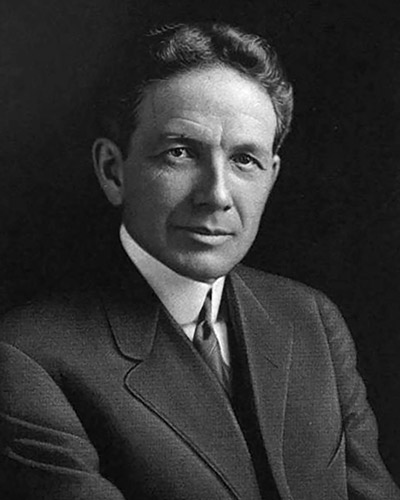
William C. “Billy” Durant
The Charles Stewart Mott Foundation is celebrating its 100th anniversary this year, and it stands today as one of the most influential private philanthropic institutions in the United States, with a reach that extends across the globe.
Its origins, however, are deeply rooted in a specific time, place, and individual: the rise of American industrial capitalism in the early 20th century, the city of Flint, and the vision of industrialist and longtime General Motors board member Charles Stewart Mott. Over the course of nearly a century, the foundation has evolved from a modest, family directed charitable vehicle into a major international grantmaking institution, while maintaining a consistent emphasis on strengthening communities as the basis for broader social progress.

Industrial Wealth and Philanthropic Beginnings
To understand the origins of the Mott Foundation, it is essential to start with William C. “Billy” Durant, because without him, there wouldn’t be a Mott Foundation, or even a Flint with an illustrious industrial history. Durant, the grandson of former Michigan Governor and Flint resident Henry H. Crapo, came to Flint after spending his early childhood in Boston. His arrival came on the heels of his parents’ divorce.
In Flint, Durant was surrounded by a phalanx of successful entrepreneurial family members, and he picked up that baton early. Billy was a success at whatever he did, and what he did best was sell. Along with his partner J. Dallas Dort, he created first the Flint Road Cart Company and then morphed that into the Durant Dort Carriage Company.
That success took him to Wall Street, and that experience informed his next move. When James Whiting and his firm was struggling with a new division attempting (and largely failing) to make engines and automobiles under the guidance of David Buick, Whiting knew the firm needed a strong leader to survive. He convinced Dort to cajole Durant to coming back to Flint to take the company over, which Durant did, parlaying Buick into becoming the number one auto manufacturer in America. From there Durant single handedly invented a brand-new company called General Motors. But during all of this action, and before he invented GM, he knew he needed a better system to support his efforts at Buick.









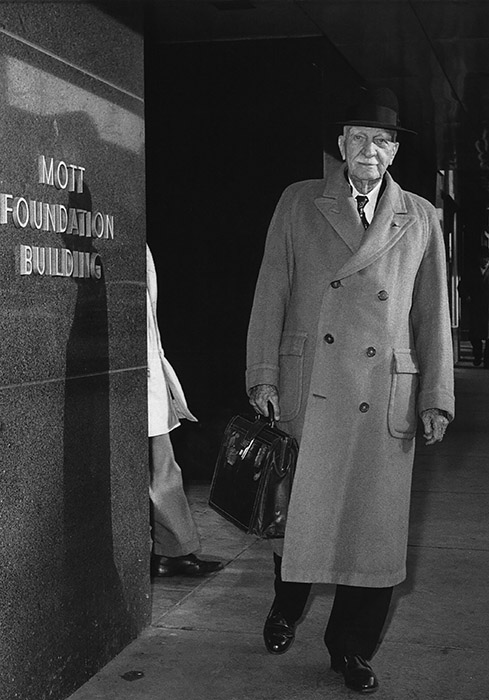
C.S. Mott leaves the Mott Foundation Building.
Photo: Charles Stewart Mott Foundation

C.S. Mott assists in repairs
to a home following a tornado in Beecher.
Photo: Charles Stewart Mott Foundation
To that end, he needed a vertically integrated company, and he would start with axles and the chief axle maker for Buick was the Weston Mott Company in Utica, New York. That firm was led by Charles Stewart Mott and his partner William Dolittle. Durant coaxed them to move all of Weston Mott to Flint with a simple letter drafted on June 4, 1905. At the time, Mott considered Flint a “Hick Town” and certainly not a place he’d like to relocate to. But after visiting with Doolittle and getting the full Flint welcome (and a very lucrative offer from Durant), Mott and Doolittle saw things differently. By 1907 they were firmly ensconced in Flint, and the Mott name became synonymous with Flint.
Mott served as a Mayor of Flint, and a key supplier to the Durant led growth of both Buick and later General Motors, growth that Durant was almost single handedly responsible for. Ultimately GM absorbed Weston Mott, Doolittle had died of stomach cancer tragically early on, and Mott was left as the sole leader. When GM fully absorbed Weston Mott, Mr. Mott (as he was always known in Flint) became a member of the board of directors of GM, and one of the world’s largest shareholders, and one of America’s wealthiest men.
At that point, he could have lived anywhere, done anything, and spent his life and time in any manner he chose. That he chose to spend it largely in service of his adopted hometown of Flint is as amazing as it sounds, and just as providential. Without the trio of Durant, Dort, and Mott, it’s inconceivable what Flint would have become. And without Mott’s next creation, a foundation, it’s even harder to imagine where it and Genesee County would be today.
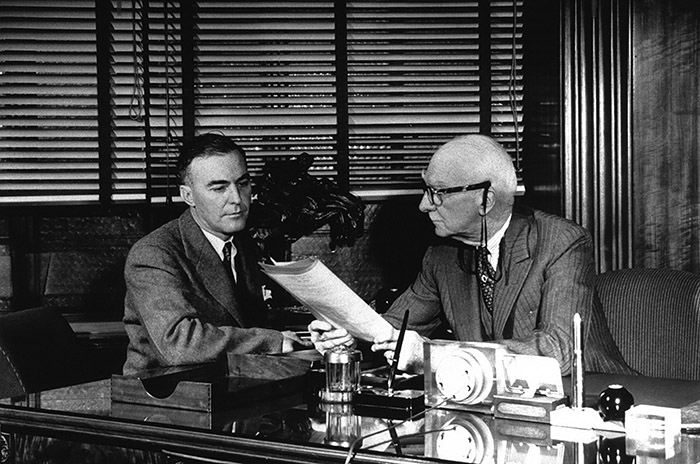
Harding Mott with C.S. Mott
Photo: Charles Stewart Mott Foundation
In 1926, Mott formalized his philanthropic ambitions by establishing the Charles Stewart Mott Foundation. At its inception, the foundation was funded with approximately $320,000 in General Motors stock—a significant sum at the time, though modest compared to the foundation’s present-day assets.
Initially, the foundation functioned primarily as a mechanism for organized charitable giving by Mott and his family. Its early activities were local in scope, focusing on improving the quality of life in Flint, the city that had become synonymous with General Motors’ growth.
Flint in the early 20th century was a rapidly expanding industrial city, experiencing both the benefits and strains of economic transformation. Population growth, urbanization, and industrial labor demands created new social challenges. Mott’s philanthropy emerged in response to these conditions, reflecting a belief that private wealth carried a responsibility to address public needs.
The Community School Movement
One of the most significant developments in the foundation’s early history came in the 1930s, during the depths of the Great Depression. In 1935, Mott partnered with educator Frank Manley to launch an innovative initiative that would become known as the “community school” movement. This approach reimagined public schools not merely as places of academic instruction, but as central hubs for community life.
Under this model, school facilities remained open beyond traditional hours, offering programs for children, adults, and families alike. These programs included recreational activities, vocational training, cultural events, and social services. The goal was to transform schools into accessible, inclusive spaces that could respond to the diverse needs of their neighborhoods.
The community school concept proved highly influential. It addressed multiple challenges simultaneously: providing educational opportunities, fostering civic engagement, and strengthening social cohesion. Over time, the model spread beyond Flint, gaining recognition at the national level and shaping broader conversations about education and community development. The Mott Foundation’s early investment in this idea established a pattern that would characterize its work for decades: identifying innovative approaches to social problems and supporting their expansion.

A community school director in Flint helps a young student put on roller skates, circa 1970. Recreational activities for residents of all ages were part of the city’s “lighted schoolhouse” approach to community education. Photo: Charles Stewart Mott Foundation
Building Local Institutions and Cultural Infrastructure
Throughout the mid-20th century, the foundation continued to focus heavily on Flint and the surrounding region. Its grants supported a wide range of local initiatives, including educational institutions, parks, and cultural organizations. Among its notable contributions was support for the Flint Institute of Arts, which became a key cultural resource for the community. These efforts reflected a holistic understanding of community well-being. Rather than concentrating solely on economic development or direct aid, the foundation invested in the social and cultural fabric of the city. Parks, arts institutions, and educational programs were seen as essential components of a thriving community, contributing to quality of life and civic identity.
At the same time, the foundation’s work remained closely tied to the fortunes of Flint itself. As a company town dominated by General Motors, Flint’s economic health was deeply connected to the automotive industry. The foundation’s local focus thus mirrored the interconnectedness of industrial success and community development.
Expansion and Transformation in the 1960s
A major turning point in the history of the Mott Foundation occurred in the early 1960s. In 1963, Charles Stewart Mott made a substantial additional contribution to the foundation, transferring a large portion of his wealth, largely in the form of General Motors stock. This infusion dramatically increased the foundation’s financial resources and transformed its capacity for grantmaking. This period also marked a shift in the foundation’s geographic and thematic scope. While Flint remained an important focus, the foundation began to expand its activities to the national and eventually international level. This expansion was influenced by broader social and political developments, including the civil rights movement, the War on Poverty, and growing awareness of global challenges.
The foundation began to support initiatives in areas such as education reform, civil society development, and environmental protection. This diversification reflected an evolving understanding of philanthropy’s role in addressing complex, interconnected issues. Rather than concentrating exclusively on local concerns, the foundation sought to contribute to systemic change on a larger scale.
Leadership and Continuity
One of the distinguishing features of the Mott Foundation has been the continuity of leadership within the Mott family. After the death of Charles Stewart Mott in 1973, leadership passed to his son, C.S. Harding Mott, and later to subsequent generations, including William S. White and Ridgway White. This continuity has helped preserve the founder’s core philosophy while allowing the institution to adapt to changing circumstances.
“Taking the Foundation into its second century is less about looking at a calendar and more about honoring a legacy of innovation, White said. “My great-grandfather believed in supporting the community and its individuals, so that together they could support each other and succeed. As we move forward, our challenge is to be a catalyst for good, for all.”
The foundation’s guiding principle—that strong communities are fundamental to individual and societal well-being—has remained central across generations. This philosophy has informed its grantmaking strategies, shaping decisions about which programs to support and how to measure impact.
White added, “Growing up in this community, I’ve seen firsthand how the Foundation’s work isn’t just about grants — it’s about people. Knowing we’ve stood alongside Flint through every triumph and every challenge for a century is deeply moving. It reinforces my personal commitment to seeing this city, and all the communities we touch, truly thrive.”
Global Reach and Program Areas
By the late 20th- and early 21st-centuries, the Mott Foundation had established itself as a major international philanthropic organization. Its grantmaking extended to dozens of countries, supporting a wide range of nonprofit organizations and initiatives.
The foundation’s work has been organized into several key program areas. These include efforts to strengthen civil society, promote environmental sustainability, expand educational opportunities, and reduce poverty. Each of these areas reflects a commitment to empowering communities and fostering long-term resilience.
In the realm of civil society, the foundation has supported organizations that promote democratic participation, transparency, and accountability. This includes funding for grassroots groups, advocacy organizations, and institutions that work to protect human rights and strengthen governance.
Environmental initiatives have focused on issues such as conservation, sustainable resource management, and climate resilience. The foundation has recognized that environmental challenges are deeply interconnected with economic and social conditions, particularly in vulnerable communities. Education has remained a core priority, building on the foundation’s early work in community schools.
Programs have emphasized youth engagement, after-school learning, and efforts to close educational gaps. These initiatives reflect a belief in the transformative potential of education as a tool for individual and community advancement.
Efforts to reduce poverty have addressed both immediate needs and structural factors, supporting programs that promote economic growth, financial inclusion, and community development. In all these areas, the foundation has sought to support innovative approaches that can be scaled or replicated.
Flint and the Foundation’s Enduring Commitment
Despite its global reach, the Mott Foundation has never lost its connection to Flint. The city remains a central focus of its work, particularly in times of crisis. One notable example is the foundation’s response to the Flint water crisis, a public health emergency that emerged in the mid-2010s. The foundation provided significant funding to support relief efforts, infrastructure improvements, and long-term community recovery.
This ongoing commitment reflects the foundation’s origins and its enduring belief in the importance of place-based philanthropy. Flint serves as both a historical anchor and a living laboratory for the foundation’s ideas about community development.
Scale and Impact in the Modern Era
Today, the Charles Stewart Mott Foundation manages assets in the billions of dollars and has distributed billions more in grants since its founding. Its influence extends across sectors and regions, shaping policies, supporting institutions, and enabling countless local initiatives. That includes over one billion given to Flint alone.
Legacy
The history of the Charles Stewart Mott Foundation is a story of evolution and continuity. From its beginnings as a modest family foundation funded by industrial wealth, it has grown into a major global institution with a diverse portfolio of initiatives. Yet throughout this transformation, it has remained guided by a consistent vision: that strong, engaged communities are the foundation of a healthy and equitable society.
This vision, rooted in the experiences of Flint and the values of its founder, continues to inform the foundation’s work in a rapidly changing world. As new challenges emerge—economic opportunity, environmental change and shifting political landscapes—the Mott Foundation’s commitment to community-centered philanthropy ensures that it will remain a significant force in shaping the future of both Flint and Genesee County.
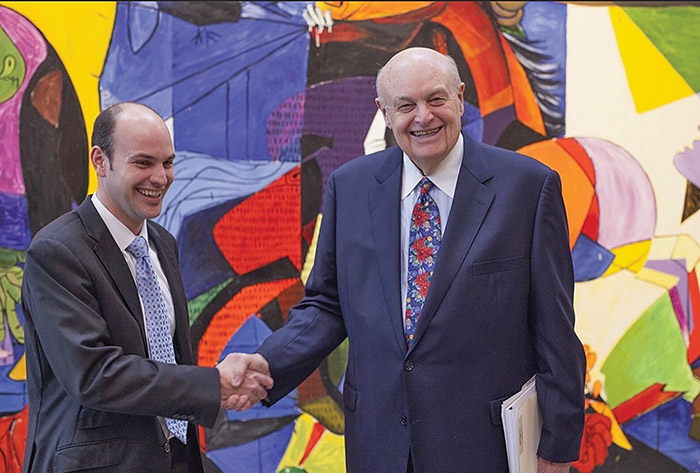
William S. White shakes the hand of his son and successor as president, Ridgway White.
Photo: Jessica Jones
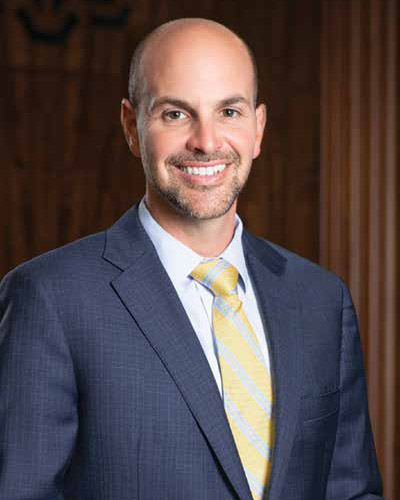
Ridgway White
Article by : Gary Fisher