








One of the great pleasures of my 40-year career in veterinary medicine has been to witness the wonderful mystery of the human-animal bond. From the time we decided to invite animals into our lives and homes, we humans have attached our emotions to our furry companions, and they, in turn, attach their emotions right back to us. This heartfelt connection with our pets creates a bond that has both physical and psychological implications for both parties.
On April 1, Mott Community College will present author and award-winning journalist John Quiñones as the first lecturer of the 2021 Ballenger Eminent Persons Lecture Series.
The scene was chaos. Police officers fired bullets and tear gas into the crowd of picketers and at the band of strikers at the gate to Fisher Body #2. Picketers and strikers retaliated by throwing rocks, bolts, door hinges and screws. A police car was flipped and the violence was escalating. Victor Reuther maneuvered the sound car (a car with a PA system mounted on the top) slowly through the crowd while shouting encouragement for strikers through a bullhorn. Sitting to his right, Genora Johnson saw an opportunity to protect the workers from police, show solidarity and calm the night. Taking the bullhorn from Reuther, she rallied the women on the street to break through the line of cops and defend their husbands, brothers and friends shouting, “we will form a line around the men, and if the police want to fire then they’ll just have to fire into us!” Women bravely heeded her call and moved to stand in the way of the cops and their weapons. The wall of women was unbreakable with cops unwilling to advance with force against it. The Battle of the Running Bulls was over, but the work of the Women’s Emergency Brigade had just begun.
When the pioneers first began inhabiting Genesee County starting in the 1830s, settlements began to dot the landscape. As more and more people came to the area to find work in lumber or grain mills, start a business, or find a home, some settlements grew into small, unincorporated villages. MCM presents the lost villages of Genesee County.
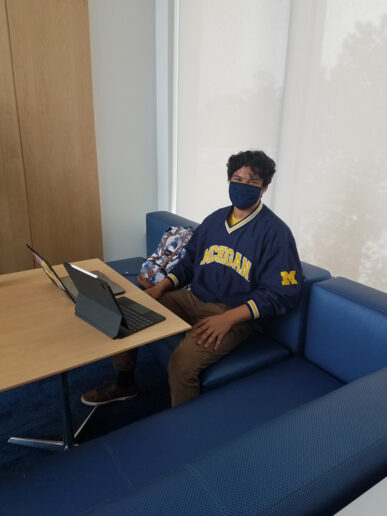
“It’s stunning,” said University of Michigan-Flint student, Manny Wright. “I’m setting up shop here. I told all my friends that from now on, if they need me, I’ll be hanging out here.” Wright was sitting in one of the student meeting areas in UM-Flint’s newly-opened Murchie Science Building Expansion. It was his first time there and he was obviously impressed. “Just walking through and looking at all of the community rooms is exciting,” he adds. “I board at Riverfront and it offers some of the same, but this is different. I’m claiming this spot.”

The year was 1995 and the once-proud city of Flint was stagnating. The mighty factories were shutting down. Citizens were fleeing to the suburbs. Schools were closing, buildings crumbling. While the city’s adults lamented a glorious past, its youth, in a valiant search for hope, desperately clung to one of the only things vibrant left in the city – its music. The Flint music scene never faltered, never flagged in the down years. In music, Flint was still relevant, still special and yet, a piece was missing. It was good, not great. Something was needed to put Flint music over the top. But, what or who? Then, from the east, with the speed of a lightning bolt a man appeared. His weapon was punk rock, his style was ridiculous, his mind warped. His name was Jim Fourniadis and with great purpose and energy, he quickly formed a band – Rats of Unusual Size. For six years, the Rats rocked the area, bringing Flint punk to its apex while instilling love for the city in a generation of adolescents, and then, just as suddenly as he appeared, Fourniadis vanished – disappeared without a trace. The Rats were no more and the people mourned.
How were you affected by the pandemic and the murder of George Floyd? While some buried their heads in the sand and took to the streets to protest, the partners of Community Roots went to the drawing board. The partners – Sylvester Jones, Jr., Patrick McNeal, Willie Smith, Jr., and Todd Womack – committed to using this time to catalyze change in their hometown of Flint and Genesee County.
The team was beaming at halftime of the Division 7 State Championship football game. Playing at Ford Field, the New Lothrop Hornets ended the first half up 35-7 against perennial championship contender, the Traverse City St. Francis Gladiators. The Hornets seemed unstoppable, but Coach Clint Galvas did his best to calm the team – they still had an entire half to play and anything could happen. “It was the best half we played all year,” stated the veteran coach. “The guys were feeling pretty good and I felt like we lost focus a little bit.” That’s understandable, as New Lothrop had absolutely dominated the first half. They scored quickly and often, holding the St. Francis rushing attack to a single touchdown. New Lothrop held the ball for only a quarter of the first half and that was all they needed to build a lead. “We really weren’t sure what adjustments to make,” explained Galvas. “We weren’t yet sure what they were trying to do.” New Lothrop buzzed into the second half with the trophy in sight; however, St. Francis wasn’t about to let it go easily.
After spending the last 20 years working tirelessly as Bishop Airport’s Chief of Public Safety, Chief Christopher Miller was ready for retirement. It was time to relax and enjoy life. “I had worked professionally non-stop for almost 39 years,” he says. “I was ready to slow down, do some traveling with my wife, Kimberly.” When Mayor Sheldon Neeley gave him a call out of the blue, he didn’t know what to expect. “He congratulated me on my retirement and told me that the city would be holding a Martin Luther King Day celebration honoring five people with the City of Flint Lifetime Achievement Award and a key to the city,” Miller recalls. “When he told me that I would be one of them, I was humbled. I had no idea. He told me that it was the highest award a citizen can be given and I am deeply honored to receive it.” At the ceremony, Miller spoke about his life in law enforcement and the people who got him there. “I didn’t do this all by myself. A lot of people helped get me to this point and I owe a lot to them,” he says. “It started with God, my mother and my father. They instilled good moral values and taught me how to communicate with and respect others the right way. Those lessons kept me out of trouble growing up.”
Willie Mack III was eight holes into his PGA Tour debut January 28 when The Golf Channel’s cameras found him.
Since the city’s beginning, African Americans have been an important part of Flint’s growth. They have made and continue to make significant contributions to the advancement of civil rights, education, culture, arts and the community as a whole for every citizen, regardless of color or national origin. In honor of Black History Month, My City Magazine would like to honor some of the many African American leaders and trailblazers, past and present, who have worked for the betterment of the city and its people.
As a criminal defense attorney, Nick Robinson is used to long days. Maintaining a successful legal practice and representing clients is as stressful as it is rewarding. Being mentally and often physically exhausted at the end of a workday is commonplace; so, it may come as a surprise to most that after the kids have gone to bed, he isn’t quite ready to hang up his coat. “I put my kids to bed, give my wife Kara a kiss on the cheek and head out to the garage,” explains Robinson. “I turn on a podcast and start the pottery wheel. I can usually churn out about ten mugs a night.”