








BROWSING:  Articles

Based in Flint, Kuhmute is leading the way in electric vehicle (EV) infrastructure providing a place for people to rent or charge an EV in cities across the United States and Canada. “We have hubs in Michigan in Detroit and Grand Haven,” says Kuhmute Software Engineer Eddie Wenzel, “and we have hubs in Illinois, Arizona and Ontario in Canada. We currently have nine in Flint with a plan in place for five more.” Kuhmute charging hubs are revolutionizing the way cities and towns think of mobility by providing a way for pedestrians to “motor” about town in a more fun and cost-efficient manner.

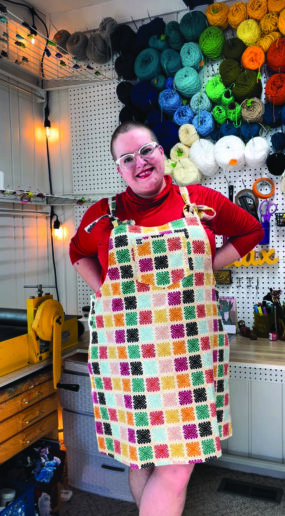
For local artist Janice McCoy, making art is as necessary and natural as breathing or drinking water. She loves to draw and paint but works primarily in linoleum printmaking. “I’ve loved making things since early in my childhood,” she shares. Her fondest memories are of drawing in kindergarten and different elementary school art class projects. She also took art classes in middle school and high school but was never really encouraged to look at art as a viable career option.
Melissa Koronka, a science teacher at the Accelerated Learning Academy (ALA) in Flint, was chosen to receive the Cranbrook Institute of Science 2022 Outstanding Educator Award. Every year, Cranbrook hosts the“Women Rock Science” gala, which recognizes three individuals who are making a difference in the fields of Science, Technology, Engineering, Arts and Mathematics (STEAM). The award recipients will be recognized at the fifth annual gala held on October 12 in Bloomfield Hills.

From the mid-1940s to the beginning of the 1960s, Flint was operating at peak efficiency and success. General Motors was nearly unrivaled in car production, Flint schools were the envy of the state in both education and sports programs, impactful social groups and organizations were being started, infrastructure updated and major businesses were built. Parades and celebrations dotted the time period between multiple visits from presidents and presidential hopefuls on the campaign trail. It was also during this time that Flint proved to the nation how resourceful and close-knit a community could be after the Beecher Tornado ripped through in 1953 and disrupted hundreds of lives. The mayors of this time period had to simply sit back and let progress happen and were mostly concerned with necessity improvements (water) and expansion.

About Huckleberry Railroad

There’s a place in Fenton where all the meats are cooked “low and slow” and the results are absolutely delicious. Beale St. Smokehouse BBQ recently moved to a new location, the former John’s Pizzeria & Restaurant. Co-owned by Phil Canup and his daughter Lisa Reading, the eatery has been serving real Memphis-style slow-smoked pork, brisket, ribs and chicken since 2006.

Founded in 2017 by Pastor Derrick Watkins of Jachin Baptist Church in Flint, Active Boys In Christ (ABC) is a mentoring program that works directly with children and families. The mission of the charitable organization is to “empower the Flint community youth and families through skilled trades, culinary and life-skills that will promote and celebrate lifelong learning for the success of youth and families.”

It’s all about the show. When that first note hits, when the riff takes off, Vicariant explodes. “It’s all energy and right from the start we are all into it,” says guitarist Jake Morrison. “We just want to play anywhere and everywhere,” adds guitarist Zak Held. “Really, we believe success is 40% music and 60% show.” The band’s frenetic live performances and raucous rock sound has been turning heads in Greater Flint and around the state since its inception nearly a decade ago. Their reputation is such that they were voted “Favorite Local Band” in the My City Magazine 2022 City’s Choice Awards, despite not being able to play a local live show since the pandemic began. It was an award of anticipation for their next big production. “Yeah, when I first heard that we had won, I was shocked,” says Held. “I mean, we haven’t been able to play live much for nearly two years.” That will change soon in a big way with the band rumbling straight forward, refreshed and hell bent on a dynamic end to the year with new music and upcoming shows.

A Certified Tourism Ambassador for around six years, Amber has been the Back to the Bricks® Executive Director since January 2020. Once chosen for the position, she shifted straight into high gear, coming up with new ideas for growing the event and attracting a younger crowd to appreciate Flint’s rich automotive history. She will be on hand for the Tune Up Week Parties happening around Genesee County during the week of August 8-13 2022. While Amber has been super-busy promoting Back to the Bricks, she took some time to answer a few questions and let us get up-close and personal … read on!

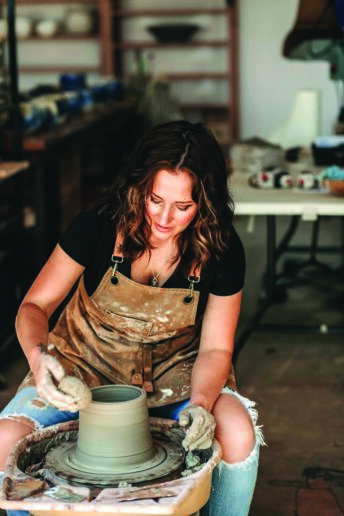
At Native House Ceramic Co., Meg Bundy harnesses the beauty, power, durability and forgiveness of the earth and its elements to create timeless inspirations and facsimiles of our planet and our shared ancestral stories. “The Earth is our shared native house,” she states. “We all have an innate ability to live closer to nature.”


In the late 1920s, Flint was hoppin’. The automobile industry was driving population, production, innovation and expansion. The city as we know it today was mainly shaped during this time period. In 1928, Hurley Hospital was built, the Kearsley Dam was installed forming the Kearsley Reservoir, the Flint Institute of Arts was founded by George Crapo Wilson, Northern High School was opened on McClellan Avenue (the first Central-Northern football game was held as a result), the Capitol Theatre opened its doors and the C.S. Mott Foundation bestowed its first grants. General Motors was in the middle of record-breaking success and, in 1928, built its 5 millionth car. They were the law of the land and employed nearly 80% of all working men in the area. Flint was a GM town and, with a change in public charter, ruled it from the top down … that is until a little event that happened in 1936 changed the public support to that of the working man.

Established in 1946, the Genesee Conservation District (GCD) was created to protect the environment and natural resources in Genesee County. “We are a grassroots organization,” explains Administrator Angela Warren. “The GCD was formed as a result of the effects of the Dust Bowl in the 1930s. Our aim is to work with landowners and land managers of public and private land to implement conservation best management practices.” Like other Michigan Conservation Districts, GCD is governed by a local, publicly-elected, five-member board serving four-year terms.