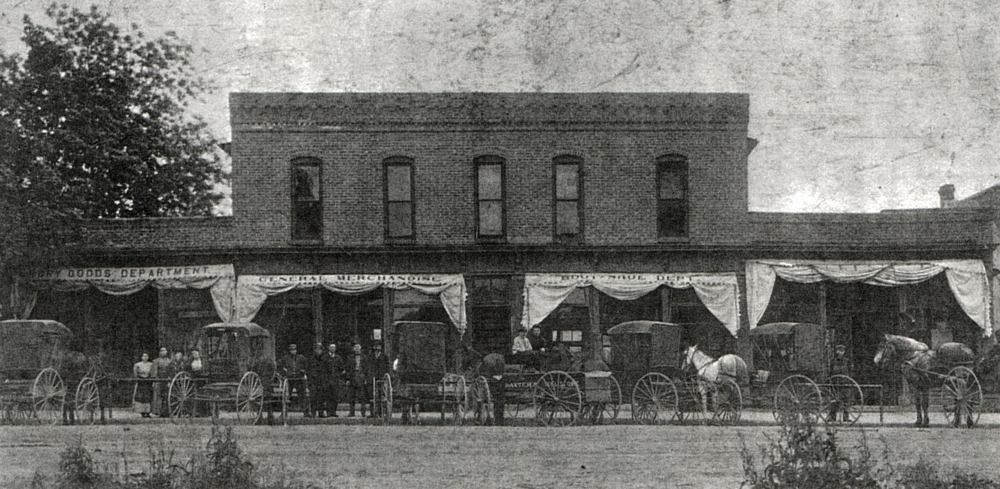










Barely containing his enthusiasm, A.B.C. Hardy was waiting. He had to talk with Billy. He had seen the future and Billy Durant needed to know what it held for the Durant-Dort Carriage Company. Hardy fidgeted with the hat on his head as the doorknob turned and Durant stepped out of his office. “Billy,” he stood and said, removing his hat. “Hello, Alexander,” said Durant as he shut the door behind him. “How was Europe?”
As his sons played in the field, Seymour Ensign packed up the last of his belongings. His wife watched over the two boys, her hand shading her eyes from the morning sun. Ensign’s friend, Thomas L. L. Brent, on whose lands he spent the first year of his life in Genesee County, was waiting to shake hands. In the township of Pewonigowink to the north sat the house Ensign had been working on for the last few months. It was finally finished and his family would be leaving Brent’s farm today to try their hand at pioneer life on their own. He tossed his rucksack into the wagon and called for his family. As they climbed into the wagon, he expressed his thanks to Brent who wished him well and good luck. Soon, the Ensign family was off to settle the last open land around. Ensign had found his home and couldn’t wait to join the other men and women with the courage and heart to tame the wild – to lay the foundation for the future of Genesee County. Hear, hear! To the pioneers!
The people of Forest Township were having a merry time at a party at the home of William R. Smith. The young folks were smiling and dancing, the older pioneers were sipping drinks and talking of politics, hunting and farming. With a revelation of great mirth, the oldest gentleman in attendance, Nathan Smith, proposed a “mock” wedding to further enliven the occasion. Everyone laughed when the homeowner took the hand of Miss Sarah Begel and volunteered the two as tribute. The crowd hushed as Nathan Smith performed the ceremony. “You may kiss the bride!” Mr. Smith announced to much jubilation. William Smith held Miss Begel and kissed her deeply while the crowd cheered with delight. It was then that Nathan Smith told the crowd that they had just witnessed a bona fide marriage! As he was Justice of the Peace, the “mock” ceremony was legally-binding. The new Mr. and Mrs. William R. Smith smiled – it was their plan all along. The roar from the spectators was deafening and the couple received many congratulations. The pioneer and his wife would be together the rest of their lives.
Let’s test your knowledge! How much do you know about the city you love? My City Magazine is issuing a challenge with 20 trivia questions. Just answer to the best of your ability (no cheating, you crazy Googlers). Good Luck!
John Reed was missing and residents of the “English Settlement” area of Flushing were worried. He was known as a man of fiery nature who often ran into trouble. His friends feared that his temper had gotten the better of him – and it had – just not in the way they thought. Being from overseas and not accustomed to pioneer life, those in the English Settlement had a way of mucking things up in the early days. So, when Reed was found sleeping in the forest wearing a single boot and accompanied only by his cow, it wasn’t surprising. The evening before, he had become incensed that his cow wouldn’t listen to him. It repeatedly ignored his commands, instead content to simply chew grass and swat flies. In his anger, Reed berated the cow and chased it into the forest where he became lost. Being hungry, he took off a boot, filled it with milk and drank. When the locals found him covered in bug bites asleep against a log next to a boot covered in milk with his lone cow, they all had a great laugh. The English had a lot to learn.
At Todd’s Tavern, the conversation was boisterous. Pioneers and travellers from throughout the new country were sharing stories of new lands and new adventures. The air was one of triumph and good cheer. In the corner, tucked away from the revelry, sat Benjamin Pearson, a New Yorker. He had heard tales of the beautiful Michigan land and travelled far to see it. He was amazed – the land was exactly as they said it was, and more. Filled with game, winding rivers and rolling hills, it was to be his new home. As he sat in revelry, four more travellers entered the tavern. Pearson couldn’t contain his enthusiasm when he learned the men were also looking for land and hailed from the county of his birth. The four men were Lewis Buckingham, Isaac N. Robinson, John Pratt and Richard Marvin. Hoping for them to be future neighbors, Pearson took the four men to the area he had chosen to settle. Three of the four were in awe of the natural splendor. The next day, the men made a trip to Detroit and entered their claim. All but Marvin became some of the first residents of the land that would one day become Mount Morris and Genesee Township.
As history continues to grow with the times, there are certain little side stories, certain tiny ideas that stick in the collective mind of the populace. These stories are handed down from person to person through generations until they achieve the status of legend or myth. Greater Flint has more than its share of these “little side stories” that give our area a local and unique flavor.
In the early 1830s, the Goodrich brothers, Moses and Enos, were living a good life in Clarence, New York but they dreamed of building a new life in a new place. They heard tales of beautiful, fertile land in the undiscovered area surrounded by the Great Lakes called Michigan. They spoke with their father Levi, supervisor of the town of Clarence, wished him and the rest of the family well and set off on their adventure. They landed in Genesee County in 1835 and found that the stories were true. The rivers were flowing and the well-lumbered land was perfect for crops. The brothers purchased 1,000 acres on which they built a log cabin and after staying for a time surveying their land, realized that they had found the best place for the Goodrich family. They traveled back to New York and in February of 1836, returned to build their legacy.
The bricks of Saginaw Street, the iconic buildings, the land and people of Flint have been part of a deep and impactful history. It’s a history that has helped to shape not just the life of its citizens, but also the course of the nation and beyond.
What is Juneteenth and why is it celebrated? According to history.com, Juneteenth, also known as Freedom Day, is short for June 19 and, broadly speaking, commemorates the effective end of slavery in the United States. It is considered the longest running African American holiday.
The race was on. In 1830, James Murray lived with his family in Superior, Washtenaw County in Michigan but wanted something more. After purchasing four acres of land in what is now known as Argentine, he moved his family with plans of starting his own mill. When he arrived, he quickly realized that someone was already working on that very same dream. William Bennett had moved into the area months earlier and was already making progress. Undaunted, Murray kicked himself into high gear. He first established a dam in what would become the village proper and then, worked day and night on his own mill while keeping a close eye on Bennett’s work. Soon enough, Murray’s mill was finished before Bennett even knew what was at stake. Bennett, upon realizing his defeat, moved south into Livingston County. Murray had won and quickly established the area’s first goods store, cooper shop, blacksmith shop and hotel. The future was bright.










View this profile on InstagramMy City Magazine (@mycitymagazine) • Instagram photos and videos