





From bustling downtown parades to mall madness and modern-day memories —
a look back at how generations have celebrated the holidays together
Christmas in Flint and Genesee County through the years tells a layered story — one of industrial prosperity and later economic challenge; of community tradition in a city shaped by the auto industry; of holidays celebrated against a backdrop of changing social and economic tides.
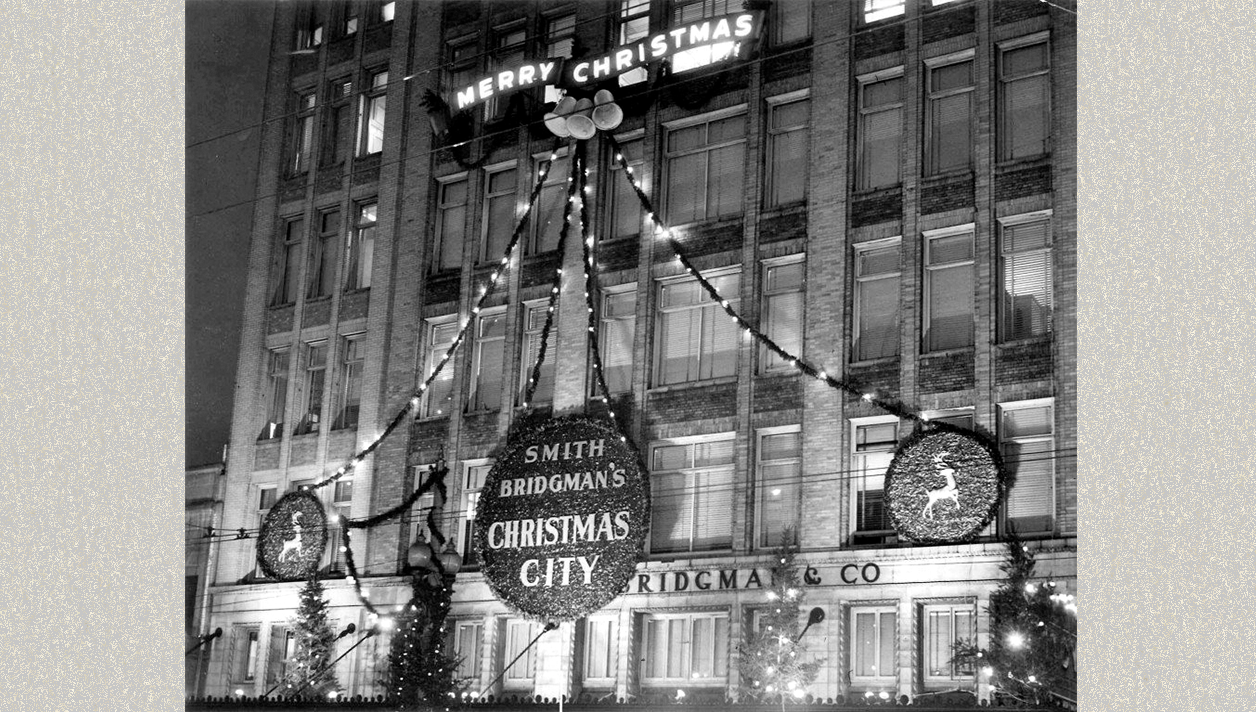
From the earliest days of the area until the early 1970s, Downtown Flint was the epicenter of Christmas activity. With the magnificent anchor store of Smith Bridgman surrounded by every imaginable variety of retail shop, it was a magnet for Michiganders — rivaled only by downtown Detroit.
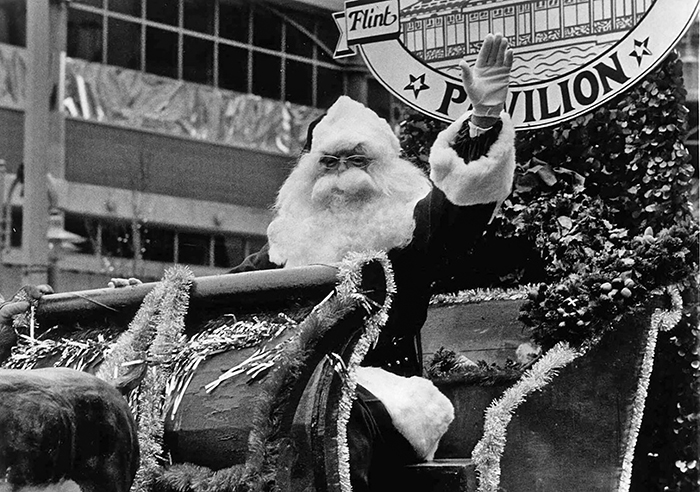
Photo courtesy of Genesee County Historical Society

The boom was fueled by the exponentially expanding automobile industry that flourished in Flint, led by the monolithic presence of General Motors — with Buick, Chevrolet, AC Spark Plug, Fisher Body, and scores of subsidiaries and ancillary businesses, all serving the leading company in the leading industry of the leading industrialized nation on earth. Hard to top that.
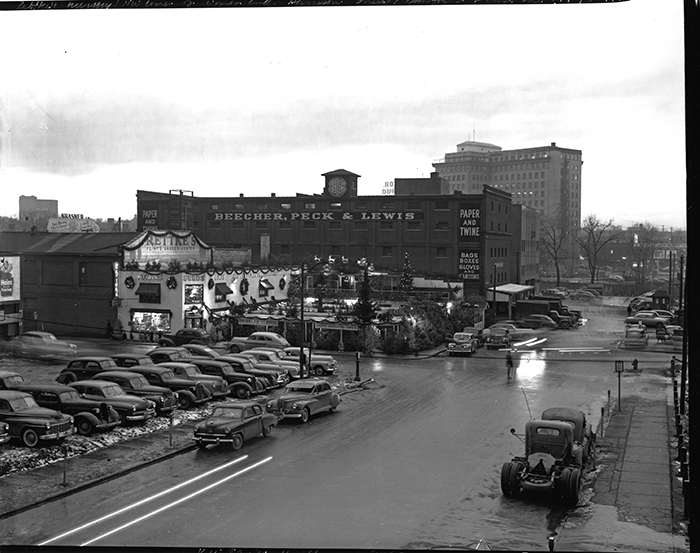
Photo courtesy of Genesee County Historical Society
Downtown shopping and events included Christmas parades featuring Santa Claus and his reindeer, all leading up to the biggest of big Santa events — getting your picture taken with the frosty, benevolent provider of Christmas joy. And where else could this take place but Smith Bridgman’s? That’s exactly where thousands of Flint-area kids showed up every year for their annual photo op with the Great Bearded One — Kris Kringle himself.










In an era long before cell phone cameras, Facebook, home computers, social media, or the internet, these pictures still managed to go viral. Families could order a paper-framed photograph of their child with Santa and send it out to relatives and friends — and scores of Flintstones did exactly that for decades.
This had long been a cherished tradition. As the decades turned — from the beginning of the 20th century, through the Roaring ’20s, and into the dark days of the Great Depression — downtown Flint remained the place to be at Christmas. While the number of gifts under the tree may have been smaller during leaner times, the community spirit and desire to gather and celebrate never waned.

Taken in 1969, this photo shows the Burning of the Greens at Kearsley Park. The Flint Recreation and Parks Department created this annual event in 1953 so that residents could get rid of their used Christmas trees and other natural holiday decorations. | Photo courtesy of Genesee County Historical Society
In fact, the season’s kickoff had a very specific communal date: the annual Flint Central vs. Flint Northern “Turkey Day” Thanksgiving game at Atwood Stadium (see November My City article). After the final whistle at Atwood, it was “game on” for a great family dinner — and the unofficial start of the Flint Christmas season.
It’s fair to call it the “Flint” Christmas season, too, because that’s where the great preponderance of shopping took place. There wouldn’t be much retail elsewhere until the late 1960s — but that’s getting ahead of the story.
By the 1940s, World War II had reshaped life everywhere, yet Downtown Flint maintained its lofty status as the place to be, especially when the boys came home from the war. With the nation yearning for normalcy, the downtown Christmas experience boomed once again.
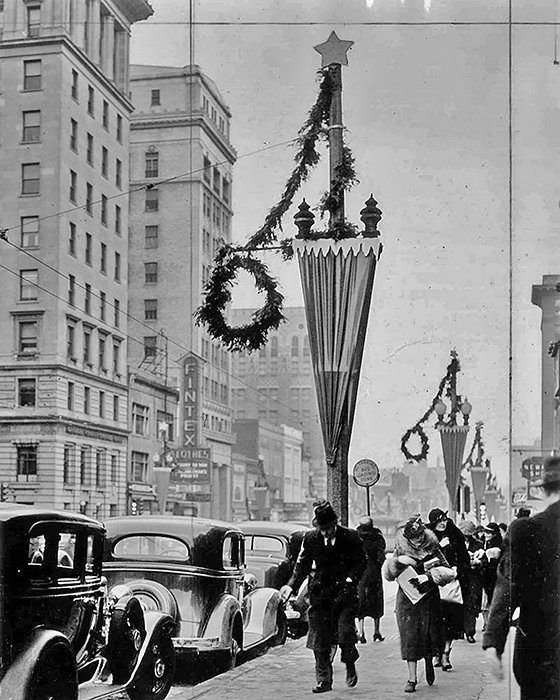
Photo courtesy of Genesee County Historical Society
Alongside “Smith B’s,” stalwarts of downtown retail thrived: Allsports, Mullins Sporting Goods, multiple coney islands, Shippe’s Cafeteria, A.M. Davison, Hubbard’s, Grinnell’s Music, The Vogue, Maas Brothers, Martin’s Dry Goods, Sears, J.C. Penney, Woolworth, Kresge’s (and before that, Buckingham’s on the same site), Rettke’s Garden Center, Fintex, Lerner’s, Bush’s, and many more.
By the midpoint of the century, Flint was on an unprecedented roll. General Motors was the master of the universe in auto manufacturing. Employment was plentiful for anyone willing to work. The city’s park system was second to none. Top entertainers regularly performed at the IMA Auditorium, and the Flint Community Schools program — coupled with the Flint Olympian and CANUSA Games — produced some of the most talented academic and athletic stars in the nation. To top it off, Flint boasted the highest per-capita income in America.

Genesee Valley Mall in the 1980s | Photo courtesy of Genesee County Historical Society
In the neighborhoods, Christmas traditions flourished, too. On the west side, it was skating at Bassett Park. On the north side, neighborhood Christmas parties were held at Berston Field House. And on the east side, Kearsley Park took center stage.
The park’s hills were originally contoured to form an amphitheater that was never completed. Instead, they became a natural setting for baseball in summer — and for sledding and tobogganing in winter. To increase the fun, the city even added a toboggan run.
Then in 1953, the Flint Recreation and Parks Department created an iconic east-side tradition: the Twelfth Night post-Christmas celebration, locally known as the Burning of the Greens. Residents brought their used Christmas trees, dried wreaths, and other natural holiday decorations to Kearsley Park, piling them in the baseball diamond area known by players as “K1.” When the pile was lit (like a Christmas tree!), it became a massive public bonfire.
You could trace the ritual back to the ancient Celts celebrating the winter solstice — but this was distinctly Flint. East Siders sipped schnapps, hot chocolate, or hot chocolate with schnapps. Kids ran and played around the fire while a shared spirit of celebration filled the cold air, mingling with smoke, sparks, and the unmistakable scent of pine.
At the 1969 event, more than 3,000 people attended. One hundred children performed a pageant about Christmas traditions, and Twelfth Night singing was led by students from St. Luke’s Catholic School.
By the 1970s, however, Downtown Flint had taken a decided turn for the worse. The opening of the Genesee Valley Shopping Center in Flint Township became the catalyst for a mass exodus of shoppers and stores from downtown to the suburbs. The city’s struggles to adapt were compounded by shrinking revenues.
The 1960s had already seen satellite shops of major downtown retailers opening in places like South and North Flint Plazas, and retail growth was booming in Grand Blanc. Between 1967 and 1972, downtown Flint sales receipts dropped by 32%. Between 1977 and 1980, downtown had largely become a ghost town at Christmas.
Meanwhile, Genesee Valley and the Eastland Mall in Burton (later renamed Courtland Center) were thriving. Throughout the 1970s and ’80s, they became the new holiday hubs. At “The Valley,” you couldn’t find a parking spot at Christmas — the same was true elsewhere. The venue had changed, but the experience remained: a communal celebration of the season. Even Santa moved his seat — if you wanted to meet him, you headed to Flint Township instead of downtown.
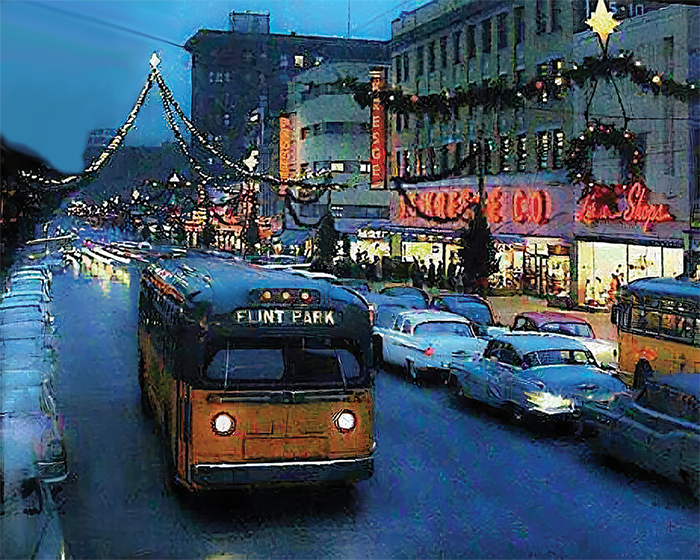
Downtown Flint in the 1980s | Photo courtesy of Genesee County Historical Society
In fact, the malls were generating revenues Flint had never seen before. For several major retailers like J.C. Penney, Flint became their most profitable location in America.
Now, in the 21st century, changing demographics and the decline of malls have led to another dramatic shift.
Flint still lights up the Mott Foundation Building downtown and hosts a lovely tree-lighting ceremony. Each of Genesee County’s satellite communities has its own traditions. But the large, collective community celebrations — the retail magic of downtown and the packed malls — are long gone.
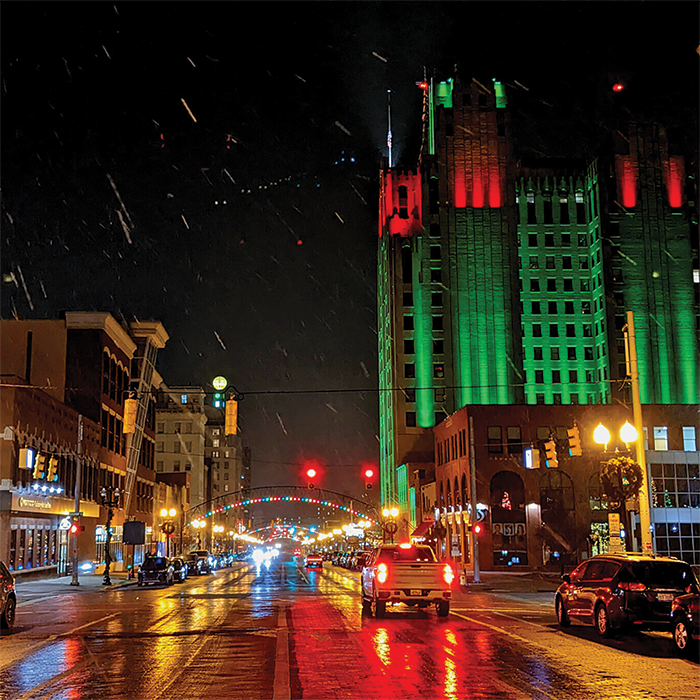
Recent Downtown Flint at Christmas time | Photo courtesy of Genesee County Historical Society
Indeed, shopping on Amazon is the antithesis of a communal experience. While it offers unmatched convenience and time savings for an overstressed, overcommitted population, it lacks the warmth and togetherness of Christmases past. That’s not nostalgia talking — it’s fact. Maybe the trade-off is worth it in time saved. Maybe it’s not.
Regardless of how one feels about the change, you’ll never convince this writer that a Ring doorbell alert for another package delivery could ever match the joy of bumping elbows with fellow shoppers on snowy Saginaw Street; grabbing a coney at “The Valley” while juggling bags of gifts; shouting to a friend across the crowded mall; or listening to kids sing carols in the park while sipping cocoa — maybe with a splash of schnapps — as a thousand Christmas trees blaze one last time.