









Genesee County’s history has its fair share of heroes. From businessmen, star athletes and entertainers to doctors, philanthropists and Civil Rights leaders, the area has certainly produced and when the country needed its people in the tragedy that is war, Genesee County answered the call sending troops wherever they were needed, no matter the conflict. When Confederate troops fired on Fort Sumter on April 12, 1861, Lincoln issued the call to arms and Genesee County acquiesced, sending every able-bodied person it could muster.
Okay, I took liberties … a few. (We’ll get to that.) When researching Oren Stone and the Flint Woolen Mills for this month’s story, I coined the term “Oren Stone and the Neptunian Pantaloons” to which our editor replied, “that sounds very Harry Potter.” I agreed, and then realized that it also sounded very “Lewis Carroll.” After that realization, I simply couldn’t resist having a little fun with it.
In 1912, General Motors was on the verge of bankruptcy. Billy Durant started the holding company in 1908 by acquiring multiple automobile and parts manufacturers – and he didn’t stop. He continued to acquire more and more businesses and GM quickly became overextended, creating problems with the banks. The majority of his acquisitions were bleeding cash and one of the company’s only shining parts, the Buick division, couldn’t make up for the losses. Durant was ousted and in his place, the bankers made a surprising choice. By the end of the year, Charles W. Nash, former head of Buick, would be in control of one of the biggest companies in the world – a far cry from his start as indentured servant.
The crowd was going crazy at Dort Memorial Field. The inaugural Thanksgiving Game between the Central Red-blacks and Northern Eskimos was scoreless midway through the fourth quarter and Central had just made the first mistake. The Red-blacks were pegged back against the goal line when the running back fumbled the ball while fighting for more yardage. A scrum ensued and when the pile was finally sorted out, the ball was in the hands of an Eskimo on the one-yard line. Now, with all the momentum on his side, Northern’s quarterback, Joe Supak, needed to capitalize. Just a year before, he and all of his current teammates were lining up alongside their Central adversaries and joining them in classes and rallies. At this moment, Supak had the chance for glory and bragging rights over his former friends. The crowd hushed as Supak started his cadence. On “three!” the ball was snapped. Supak took the ball and leapt forward under the protection of his linemen, extending the ball forward as far as he could reach. When the play was over, the ball had crossed the goal line and after a perfect extra-point kick, Northern led 7-0. After holding off a frantic comeback attempt by Central, Northern left for Thanksgiving dinner as winners. The rivalry holiday game would last for nearly 50 years with the final game played in 1976 and won by the Central Indians 7-6.
W. Howard Squire was at the plate. It was the 13th inning and Flint High was tied with the juggernaut team from Ann Arbor, 7-7. Flint wasn’t supposed to have a chance. The Ann Arbor team was noted as the best in the state. Their pitcher was dominant, but Flint got to him early, scoring all of their seven runs in the first two innings. Ann Arbor fought back and tied it in the ninth, sending the game to extras. Squire took a called strike right down the middle of the plate, bringing the count to full. He stepped out of the batter’s box and looked to third base where Pee Wee Barkey landed after his two-out triple. One hit from Squire would bring Barkey home and end the game, sending the packed crowd at Atwood Stadium into a frenzy.
The air was still. T.B.W. Stockton and his men stood quiet and ready. In just a few minutes time, the Battle for Gaines Mill would begin, throwing the field before him into chaos and his men into danger. Earlier that spring, General Stonewall Jackson harassed the Union Army throughout the Shenandoah Valley, slowly whittling away at it; while General Robert E. Lee amassed a huge number of men for a vicious assault, starting with Gaines Mill. It was up to General Fitz John Porter’s corps to stem the tide of setbacks and continue McLellan’s advance on Richmond. Stockton and his fellow union soldiers were outnumbered, but confident that they will be able to hold.
The scene was chaos. Police officers fired bullets and tear gas into the crowd of picketers and at the band of strikers at the gate to Fisher Body #2. Picketers and strikers retaliated by throwing rocks, bolts, door hinges and screws. A police car was flipped and the violence was escalating. Victor Reuther maneuvered the sound car (a car with a PA system mounted on the top) slowly through the crowd while shouting encouragement for strikers through a bullhorn. Sitting to his right, Genora Johnson saw an opportunity to protect the workers from police, show solidarity and calm the night. Taking the bullhorn from Reuther, she rallied the women on the street to break through the line of cops and defend their husbands, brothers and friends shouting, “we will form a line around the men, and if the police want to fire then they’ll just have to fire into us!” Women bravely heeded her call and moved to stand in the way of the cops and their weapons. The wall of women was unbreakable with cops unwilling to advance with force against it. The Battle of the Running Bulls was over, but the work of the Women’s Emergency Brigade had just begun.
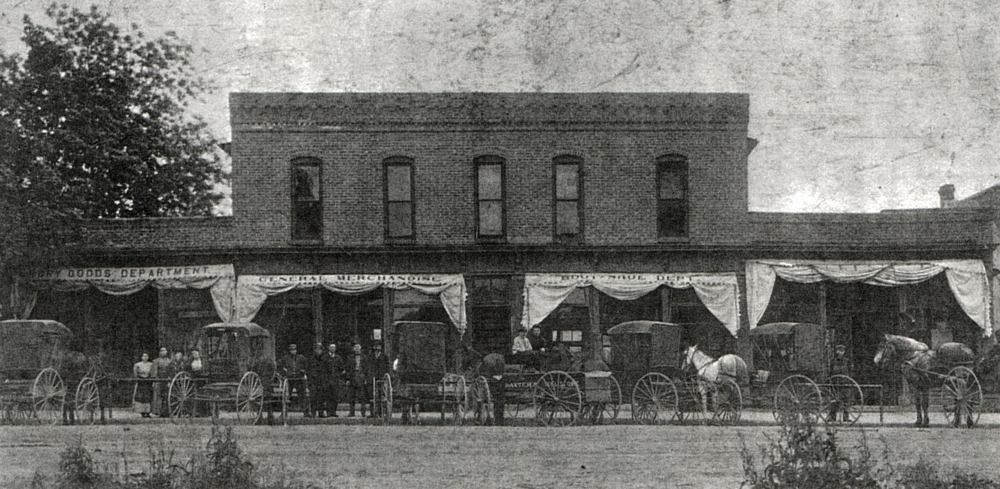
When the pioneers first began inhabiting Genesee County starting in the 1830s, settlements began to dot the landscape. As more and more people came to the area to find work in lumber or grain mills, start a business, or find a home, some settlements grew into small, unincorporated villages. MCM presents the lost villages of Genesee County.
Barely containing his enthusiasm, A.B.C. Hardy was waiting. He had to talk with Billy. He had seen the future and Billy Durant needed to know what it held for the Durant-Dort Carriage Company. Hardy fidgeted with the hat on his head as the doorknob turned and Durant stepped out of his office. “Billy,” he stood and said, removing his hat. “Hello, Alexander,” said Durant as he shut the door behind him. “How was Europe?”
As his sons played in the field, Seymour Ensign packed up the last of his belongings. His wife watched over the two boys, her hand shading her eyes from the morning sun. Ensign’s friend, Thomas L. L. Brent, on whose lands he spent the first year of his life in Genesee County, was waiting to shake hands. In the township of Pewonigowink to the north sat the house Ensign had been working on for the last few months. It was finally finished and his family would be leaving Brent’s farm today to try their hand at pioneer life on their own. He tossed his rucksack into the wagon and called for his family. As they climbed into the wagon, he expressed his thanks to Brent who wished him well and good luck. Soon, the Ensign family was off to settle the last open land around. Ensign had found his home and couldn’t wait to join the other men and women with the courage and heart to tame the wild – to lay the foundation for the future of Genesee County. Hear, hear! To the pioneers!
The people of Forest Township were having a merry time at a party at the home of William R. Smith. The young folks were smiling and dancing, the older pioneers were sipping drinks and talking of politics, hunting and farming. With a revelation of great mirth, the oldest gentleman in attendance, Nathan Smith, proposed a “mock” wedding to further enliven the occasion. Everyone laughed when the homeowner took the hand of Miss Sarah Begel and volunteered the two as tribute. The crowd hushed as Nathan Smith performed the ceremony. “You may kiss the bride!” Mr. Smith announced to much jubilation. William Smith held Miss Begel and kissed her deeply while the crowd cheered with delight. It was then that Nathan Smith told the crowd that they had just witnessed a bona fide marriage! As he was Justice of the Peace, the “mock” ceremony was legally-binding. The new Mr. and Mrs. William R. Smith smiled – it was their plan all along. The roar from the spectators was deafening and the couple received many congratulations. The pioneer and his wife would be together the rest of their lives.